Since January 1, 2026, non-US residents aged 16 and older pay an extra $100 per person at 11 national parks, on top of the normal entrance fee. The $250 Non-Resident Annual Pass covers both fees for its holder and a qualifying group. In one private car at $35 parks, it pays off at the second fee park for one or two adults, or the first for three or more.
A nonresident is a visitor who is not a US resident; US citizens also qualify for resident pricing. For the calculations below, “adults” includes teenagers aged 16 and 17. Count everyone aged 16 or older before comparing costs.
Which parks charge the $100 nonresident fee
The NPS nonresident fee FAQ lists the following 11 parks. Sequoia & Kings Canyon is one combined entry in that list.
A per-vehicle fee pays for one private car and its passengers. A per-person fee is the normal entrance price for someone arriving on foot or by bike. You pay the relevant normal entrance price, then add $100 for each nonresident aged 16 or older unless covered by a valid pass.
| Park | Standard vehicle pass | Per person (walk/bike) | Extra fee per nonresident 16+ |
|---|---|---|---|
| Acadia | $35, 7 days | Check park page | $100 |
| Bryce Canyon | $35, 7 days | $20 | $100 |
| Everglades | $35, 7 days | $20 | $100 |
| Glacier | $35; $25 in winter, 7 days | Check park page | $100 |
| Grand Canyon | $35, 7 days | $20 | $100 |
| Grand Teton | $35, 7 days | Check park page | $100 |
| Rocky Mountain | $30, 1 day; $35, 7 days | Check park page | $100 |
| Sequoia & Kings Canyon | $35, 1–7 days | $20 | $100 |
| Yellowstone | $35, 7 days | Check park page | $100 |
| Yosemite | $35, 7 days | $20 | $100 |
| Zion | $35, 1–7 days | $20 | $100 |
Glacier's winter vehicle rate runs from November 1 through April 30. Walk/bike prices shown are standard entrance fees, before the nonresident fee. For unlisted walk/bike rates, follow the park fee pages in the sources below.
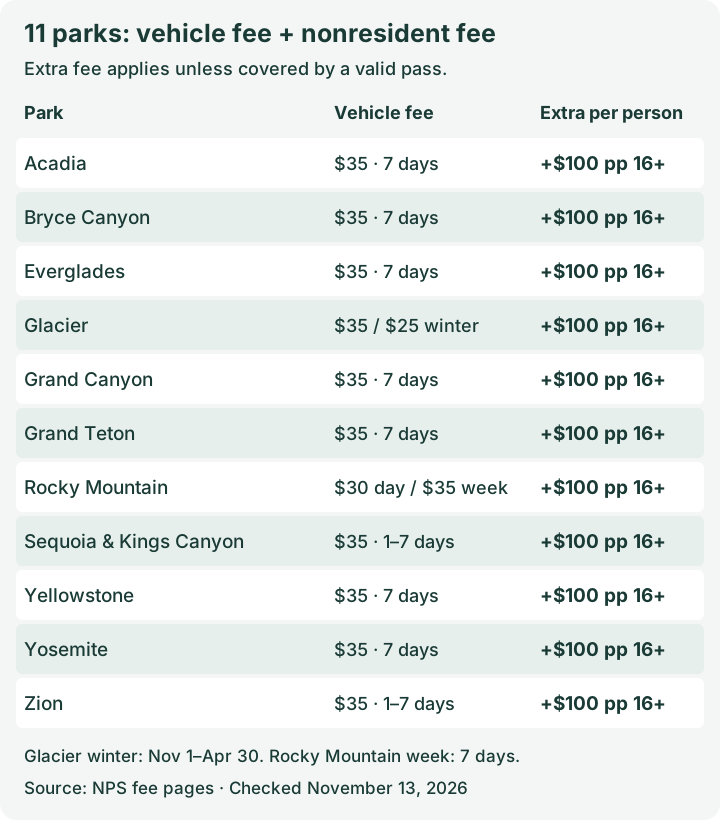
Source: NPS fee pages, checked November 13, 2026.
Who counts as a nonresident
A foreign passport alone does not tell the whole story: US citizens and residents qualify for the $80 Resident Annual Pass. NPS lists these accepted documents as proof when buying it:
- A US passport.
- A driver's licence or state ID issued by a US state or territory.
- A Permanent Resident card, also called a green card.
Visitors buying a digital pass show photo ID when they use it. If someone bought a resident pass but is not eligible, NPS says they will be asked to upgrade.
Children aged 15 and younger do not pay the $100 fee. That does not remove a private car's normal vehicle entrance charge. Count a 16-year-old in the same way as an older adult for the extra fee.
Fee or pass: what your group will pay
Own calculation: assume one private car, all adults are nonresidents, and each park charges $35 per vehicle. Without an annual pass, the cost at each park is $35 + $100 × adults aged 16+. Two parks means two separate $35 park charges and two sets of nonresident fees.
| Adults aged 16+ in one car | One fee park, no annual pass | Two fee parks, no annual pass | With $250 annual pass, either trip |
|---|---|---|---|
| 1 | $135 | $270 | $250 |
| 2 | $235 | $470 | $250 |
| 3 | $335 | $670 | $250 |
| 4 | $435 | $870 | $250 |
For a solo visitor, two parks cost $270 without the pass: $20 more than buying it. A couple pays $235 at one park, so buying the pass for that visit alone costs $15 more. At two parks, their $470 total makes the pass cheaper by $220.
With three or four adults in the car, buy the pass even for one of these $35 parks: the separate fees already exceed $250. Children under 16 add nothing to the $100 part of this calculation.
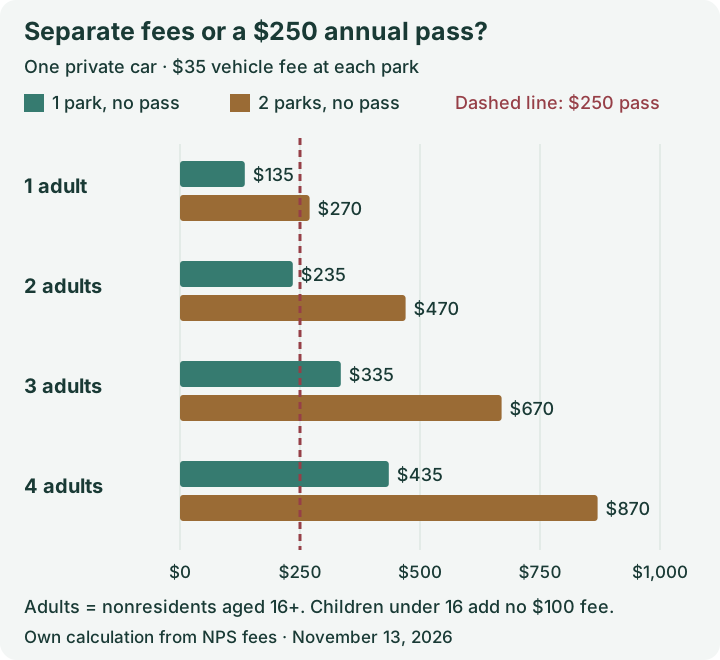
Own calculation from NPS fees: one private car, $35 vehicle entrance per park.
Use your actual route for the comparison. Our national parks road trip guide helps connect stops. A seven-day Utah national parks trip includes Zion and Bryce Canyon, both on the extra-fee list. These car totals do not apply to a commercial tour bus.
What the $250 pass covers (and what it doesn't)
The America the Beautiful pass is a shared entrance pass for federal recreation lands. Its Non-Resident Annual Pass costs $250 and covers entrance fees plus nonresident fees for:
- The holder and passengers in one private vehicle; NPS specifies up to 15 passengers.
- The holder and passengers on two motorcycles.
- The holder and three additional people aged 16 or older where fees are charged per person.
It lasts 12 months from purchase and is non-refundable and non-transferable. It also covers entrance and standard amenity fees, meaning day-use fees, on lands managed by NPS, Fish & Wildlife Service, Forest Service, Bureau of Land Management, Bureau of Reclamation and Army Corps of Engineers.
It does not cover separate reservation fees or replace required reservations. For example, Acadia's Cadillac Summit Road has a separate $6 vehicle reservation from mid-May into October.
Already have an annual pass bought before January 1, 2026? NPS says it remains valid for 12 months from purchase, including coverage of nonresident fees. Check its expiry before buying another.
NPS also accepts valid park annual passes held by someone travelling with you. But the $70 park annual passes shown on the fee pages are for US citizens and residents; they are not a purchase option for visitors from abroad.
How to buy the pass
The NPS entrance pass page explains the three purchase options:
- Digital via Recreation.gov: available immediately after purchase. Save the pass to your phone before reaching the entrance.
- At a park entrance station: buy a physical pass when you arrive. Have your photo ID ready.
- By mail from the USGS Store: the pass costs $250 plus fees totaling $7.50. Physical online orders may take up to three weeks. A receipt cannot replace the physical pass.
At Yosemite, bring a card or use mobile payment: the park does not accept cash. Its official fee page also confirms that the $35 vehicle fee alone does not cover nonresident fees.
Tours and the nonresident fee
Joining a commercial tour does not remove the $100 charge at the 11 parks. One Non-Resident Annual Pass covers the holder and three additional nonresidents aged 16 or older in that commercial group.
Ask your tour operator whether the fee is included and tell them if you hold a pass. Operators must know the number of nonresidents and pass holders before entering. Since June 2026, they can prepay through a Commercial Site Pass on Recreation.gov.
The NPS commercial tour FAQ separates commercial vehicle entrance fees from per-person entrance fees. A CUA is a commercial use authorization, the park's permission for a business to operate. The private-car calculation above is not a quote for a tour group's entrance bill.
Fee-free days don't apply to visitors from abroad
In 2026, entrance fee-free days apply only to US citizens and residents. Nonresidents pay normal entrance and nonresident fees unless covered by a valid pass. All listed 2026 fee-free days have now passed; the last was November 11, Veterans Day.
Parks without the extra fee
Outside the 11 parks listed above, the $100 nonresident charge does not apply. Nonresidents pay the normal entrance fee only, where one is charged. Compare your route before assuming every park adds $100. Our USA national parks guide has ideas for choosing stops.
Frequently asked questions
How much is the national park fee for foreigners?
Non-US residents aged 16 and older pay an extra $100 each at 11 national parks, on top of the standard entrance fee. The $250 Non-Resident Annual Pass covers entrance and nonresident fees within its group limits.
Is the $250 Non-Resident Annual Pass worth it?
In our calculation for one private car at parks charging $35 per vehicle, the pass saves money at the second fee park for one or two nonresident adults. With three or more nonresident adults in that car, it saves money at the first fee park. Here, adults means everyone aged 16 and older.
Do children pay the nonresident fee?
Children aged 15 and younger do not pay the $100 nonresident fee. A 16-year-old does. A family arriving by private car still pays the standard vehicle entrance fee unless covered by a valid pass.
Does the nonresident fee apply on a tour?
Yes. The $100 fee applies to non-US residents aged 16 and older in commercial tour groups at the 11 parks. A Non-Resident Annual Pass covers the nonresident fees for its holder and three additional nonresidents aged 16 and older. Ask your tour operator whether the fee is included.
Can I use a friend's US resident pass?
You cannot borrow a pass and use it without its holder. If you travel with the holder of a valid America the Beautiful or park annual pass in a private vehicle, NPS says it covers your entrance and nonresident fees. At per-person sites, coverage is limited to the holder and three additional adults.
Fees can change. Check each park's official fee page before you go, then compare the total for your group with the annual pass.
Fees checked against nps.gov on November 13, 2026.
Sources & References
This article is based on first-hand experience and verified with the following official sources:
- S1 — NPS Nonresident Fees FAQ↗
- S2 — NPS Entrance Passes↗
- S3 — NPS Entrance Fees by Park↗
- S4 — NPS/DOI 2026 access announcement↗
- S5 — USGS 2026 Non-Resident Annual Pass↗
- S6 — NPS Acadia Fees & Passes↗
- S6 — NPS Bryce Canyon Fees & Passes↗
- S6 — NPS Everglades Fees & Passes↗
- S6 — NPS Glacier Fees & Passes↗
- S6 — NPS Grand Canyon Fees & Passes↗
- S6 — NPS Grand Teton Fees & Passes↗
- S6 — NPS Rocky Mountain Fees & Passes↗
- S6 — NPS Sequoia & Kings Canyon Fees & Passes↗
- S6 — NPS Yellowstone Fees & Passes↗
- S6 — NPS Yosemite Fees & Passes↗
- S6 — NPS Zion Fees & Passes↗
- S7 — NPS Nonresident Fees on Commercial Tours FAQ↗

Go2USA Editorial Team
Exploring the USA since 2023 | All 50 states covered | Updated monthly
We are a team of travel writers and American travel enthusiasts who explore the country year-round. Our guides are based on first-hand experience, local knowledge, and verified official sources.
More about us →People Also Read
The Ultimate National Parks Road Trip: How to Plan an Epic American Adventure
Plan the perfect national parks road trip across the United States with our complete guide to route planning, the best parks to combine, camping versus lodges, seasonal timing, and realistic cost breakdowns.
USA National Parks Guide: The Top 12 Parks to Visit
America's national parks are called 'the best idea America ever had.' This guide covers the top 12 national parks — from the Grand Canyon and Yellowstone to Zion and the Great Smoky Mountains — with everything you need to plan your visit.

New York City Complete Guide: Neighborhoods, Attractions & Where to Stay
Complete NYC guide covering neighborhoods, top attractions, dining, accommodations & practical tips for planning your New York City trip.

Amtrak Cross-Country: Real 2026 Guide to Coast-to-Coast by Train
Can you take Amtrak coast to coast? Real 2026 routes (California Zephyr, Southwest Chief), costs ($213 coach / $1500 sleeper), and whether the 52-hour ride is worth it.
Plan Your USA Trip
Book hotels, transport, activities, and get connected with an eSIM
Some links are affiliate links. We may earn a commission at no extra cost to you.